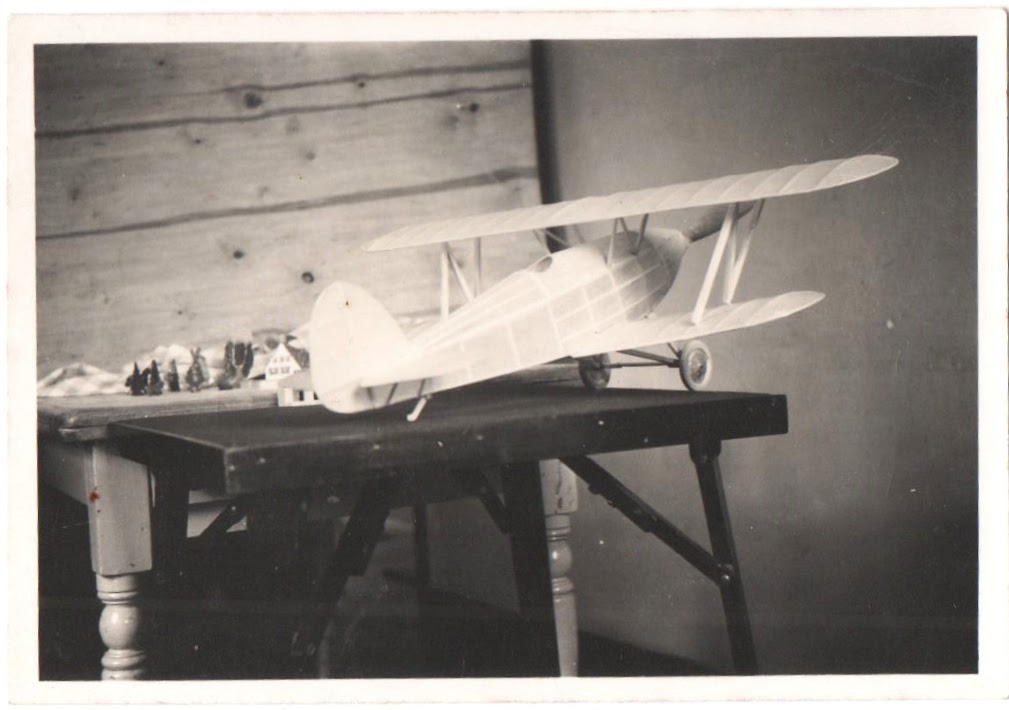
John, born 6th July 1903, was an early 20th-century person. Although he was a solicitor by profession, his interests were in current technological developments. An early hobby was making model aeroplanes from balsa wood and covering them with tissue paper
This website is devoted to John’s interest in photography, particularly the making of Cine films; the first two films were of family holidays before WW2. After the war, some of his best scenes are of family life in the garden at Maybury (the family home).
John, a regular reader of Amateur Photographer, also took still photographs and developed and printed them at home. Eventually, he built an enlarger to go on the kitchen table, using the wartime blackouts to create a dark room.
John continued making Cine films showing family holidays and life at home, changing to colour in 1955. In 1966, he bought a Russian Zenith 35mm still camera with an attachment for macro photography and a slide projector. After that, he made only three more Cine films in 1969, 73 and 76.
John entertained his family with film shows at Christmastime; throughout the war, there were only two films to show – these two films became very familiar to his older children. As the years passed, the stock of films increased, but sometimes he hired black and white silent movies to entertain the family at Christmas – e.g. Laurel and Hardy and Charlie Chaplin. One year he bought a card Charlie Chaplin with jointed limbs which he and Doris put on a thread fixed at one end; Doris held on to the other end controlling Charlie’s antics while John distracted the audience from how it worked.
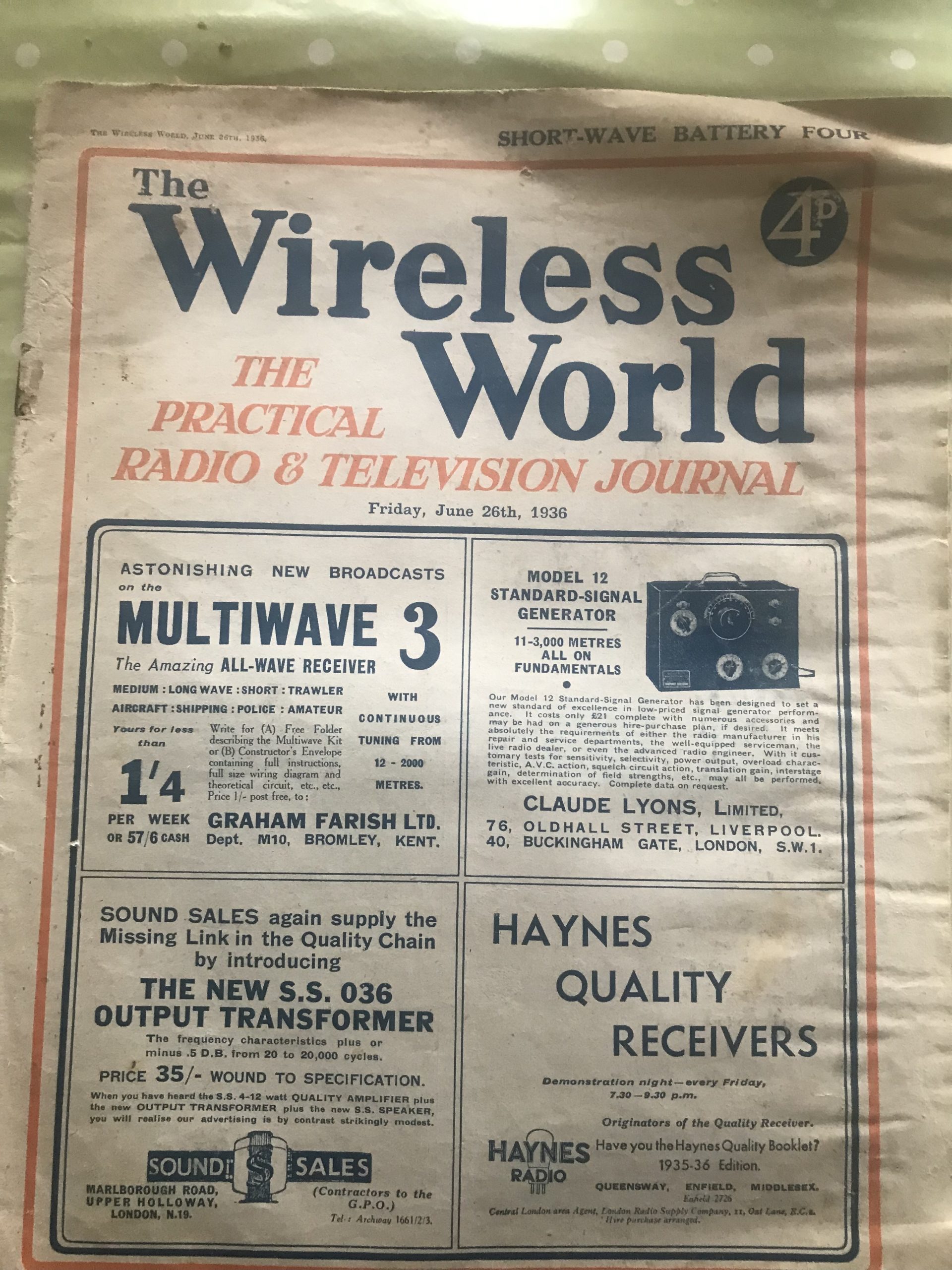
John was also a regular reader of Wireless World and applied the knowledge gained to build a Wireless (a radio) with a wooden case that stood in the corner of the sitting room from the early 1940s. This wireless system used valves to detect and amplify radio signals. He added an extension speaker in a cupboard to keep up with news and cricket scores from the kitchen. In the late ‘60s, he built a transistor radio in a new wooden case. The first radio John had made was a crystal set and he showed Jean and Sheila how to make one each for them to use.
He also understood how pocket watches worked (in the 1940s some men still had a watch on a chain, kept in the inside pocket of their jackets). He would spend hours with a magnifying glass and tweezers disassembling a watch and then putting it together again in working order. His children spent much time on their knees trying to find tiny watch parts he had dropped.
John owned a motorcycle when quite young and, in about 1922, travelled to Lewdown in Devon in one day with a friend, Maitland Mackenzie. They stayed the night at an inn and returned the next day.
And last, but not least, John had a series of interesting cars, all of which he maintained himself – a difficult task in those days: a model A Ford after marriage passed on by his father Eb, who rarely drove; then a Lanchester from the summer of 1939, a second Lanchester from 1952 to 1955, then a Daimler Consort and finally two Ford Cortinas, with automatic gearboxes
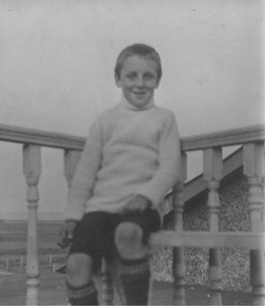
As a child, John lived in Ashgrove Road, Goodmayes, close to the Hatherly family. He had two older sisters, Amy and Madge and a younger sister Florence.
John went to Clarks College, Ilford but he told us little about the school or any qualifications he may have obtained. However, Peter has his certificates showing that John took both the School Certificate (Junior exam) and the Higher School Certificate (Senior exam), and the Royal Drawing Society Exams. John was a prefect and was good at sports: he won the Sports Challenge Cup – first in the long jump and throwing the cricket ball and second in the high jump. He was also captain of the school cricket team and played for Goodmayes Club until 1930.
After leaving school, John worked as a clerk at the Port of London Authority for two years. Then he joined his father Eb’s firm ‘E. Smith and Co.’ in John Street, where he was an articled clerk ( allowing him to train as a solicitor without a law degree). He qualified as a Solicitor in August 1928. Eb and John moved the firm to 2 Verulam Buildings, Grays Inn in 1933, where it remained until 1991. Eb retired around 1950 leaving John alone until Peter joined him in 1966. John retired in 1988, travelling two days a week outside the rush hour for the last few years. The firm’s work was largely based on debt collection for Maples of Tottenham Court Road, work which Eb brought with him from his previous firm; this continued until 1971 when Maples was taken over, by which time the work had expanded to include conveyancing, probate, wills and other matters.
John married Doris Allen on 3rd September 1932. They set up a home at 30 Colchester Drive, Pinner, where John built a garage. Jean was born in October 1934 and Sheila in March 1938. John’s first Cine film was shot on holiday in East Bavants (near Southwold) in the summer of 1938: it shows the family in the Ford VW 6741. By May 1939, they had moved to Maybury, Wheathampstead Road, Harpenden and had the Lanchester CNO 763 which appears in John’s second Cine film shot on holiday in Cornwall.
Maybury was about a mile from Harpenden station, which, at that time had steam trains to London. John used to cycle to Harpenden Station as did Jean while a student in London, Peter while still living at home and Christine while studying and working in Luton, and working in St Albans and London.
World War II changed everything: fortunately, John was too old to be called up but he had to do Air Raid Warden duties; the car was ‘put up’ in the garage and food was rationed. The big garden provided plenty of opportunity for home produce. John and Doris made a good team: he dug the vegetable plot and grew the vegetables and fruit while Doris looked after about a dozen chickens (there were egg ration coupons from neighbours and plenty of food waste from the soldiers billeted a few doors away). Doris also preserved the spare fruit and eggs for family use during the winter, also making jam and salting down runner beans. The potatoes were preserved in a Clamp.
Conditions in the office during wartime were difficult: during the blitz; bombs landed nearby and blasts blew in windows, but the firm carried on despite the difficulties. After the lull, came the doodlebugs and then the V2 rockets one of which landed at the top of Chancery Lane only a 5-minute walk from the office.
In 1940, both sets of grandparents were bombed out. First Gran (John’s mother) and then Grandma (Doris’ mother) came to stay at Maybury. Soon after that, a pair of young soldiers were billeted there.
When the end of the war was almost in sight, Peter was born in June 1944 and Christine in August 1945.
As shortages continued well into the 1950s, John and Doris’ gardening efforts continued helping to feed the family.
John talked to his children about so many practical things, including how to log a journey and calculate distance from speed and time; how to keep their bicycles in good order and to mend punctures and replace brake blocks; simple facts about electricity including Ohm’s law and how to calculate watts from volts and amps e.g. to know what fuse to use; about electric engines and dynamos and internal combustion too; all about developing and printing photographs and the need to understand how the developer worked. These things seemed so important to him that he needed to pass them on.
John had a wonderful sense of humour and loved spoonerisms besides other sorts of wordplay, for example, the Cockney alphabet (A for ‘orses, B for Mutton, etc). He showed us how to use simple codes including an amusing fast-spoken code in which words were spelled out with each consonant sandwiching the letter ‘u’ e.g ‘juj e a nun’ for ‘jean’. When asked why the wartime government-supplied chicken feed was called ‘balancer meal’, he replied: ‘to stop them falling off their perches’.
In the years following 1945, after a six-year ban, John was thrilled to organise Guy Fawkes Day for the family with a bonfire and fireworks; he would put light bangers under a metal bucket to increase the noise.
John enjoyed the company and conversation of friends. For example, in the 50s, on the train that went into Moorgate; during his lunch break when he went to the nearby Yorkshire Grey; and some evenings cycling home from Harpenden Station via the Plough and Harrow in Southdown Road. He liked a half pint and a chat; he used to say: “A chat with the ticket collector at the station or with anyone you came across took you out of your worries into a better place”.
John and Doris had a common interest in playing tennis and by 1949 he had built a tennis court and she had trained Sheila and Jean to play. There was still room for fruit bushes and vegetables and space for campfires and tents.
Holidays at the beach resumed in 1947 and continued every year until 1961, mostly at Southwold or at Eype in Dorset. They followed a regular pattern of swimming in the sea, making sand castles, playing beach cricket and building dams. In the later years, John’s holiday cine films included illustrated tours of nearby villages, e.g. Dorset in 1957 and later in Scotland in 1973.
In 1955, tennis came to an end when John and Doris took up golf, playing at Harpenden Common Golf Club and Peter and Christine joined them in April 1956; Sheila sometimes played with them. From 1960 John played golf most Saturdays with Doris and Sundays with friends and quite often Peter. John took Golf Illustrated and read books about golf so that he could advise family and friends on how to improve their golf swings.
Over the years, they enjoyed the arrival of their six grandchildren: Rachel, Julian and Jason in 1964, 1965 and 1968, Richard in 1973 and Joseph and Hazel in 1981 and 83.
John and Doris continued to take annual holidays: from 1966 to 1972 they stayed at Southdowns Hotel, near Midhurst when John needed to be within reach of the office (Peter had only been in the office 6 months in 1966). They played golf at Cowdray Park and elsewhere.
In 1972 they felt free to go on a new adventure and headed to the Mull of Kintyre to see whether they could find a place to stay near the Machrihanish Golf Club. They found Mrs Smith at Ardbay and played golf most mornings, tootling around Southend some afternoons. This suited them well and they returned every year until 1977. They took 2 days to drive to Kintyre, stopping several times at an Inn at Levens Bridge (southern Lakes) where once there was a fire in the kitchen and we heard that they escaped from the bedroom window via a low roof.
From 1978 to 1980, they stayed at a Cottage in East Witton, Yorkshire – owned by friends of Christine; the first year John had to return to work after 1 week as Peter caught mumps from Richard, but then returned.
Their final holidays from 1981 to 1983 were spent at another cottage in Gilling West in Yorkshire.
John and Doris continued to play golf until their late seventies. John finally retired from the game in 1986, Doris having stopped a couple of years before.
John continued growing vegetables and shared the gardening with Doris. He watched cricket and golf on TV, played Scrabble with Doris and still did the Telegraph crossword most days – he often completed the crossword before reaching London in his commuting days. In the early 1960s, he took up the challenge of the Sunday Times Mephisto crossword – which has no black squares.
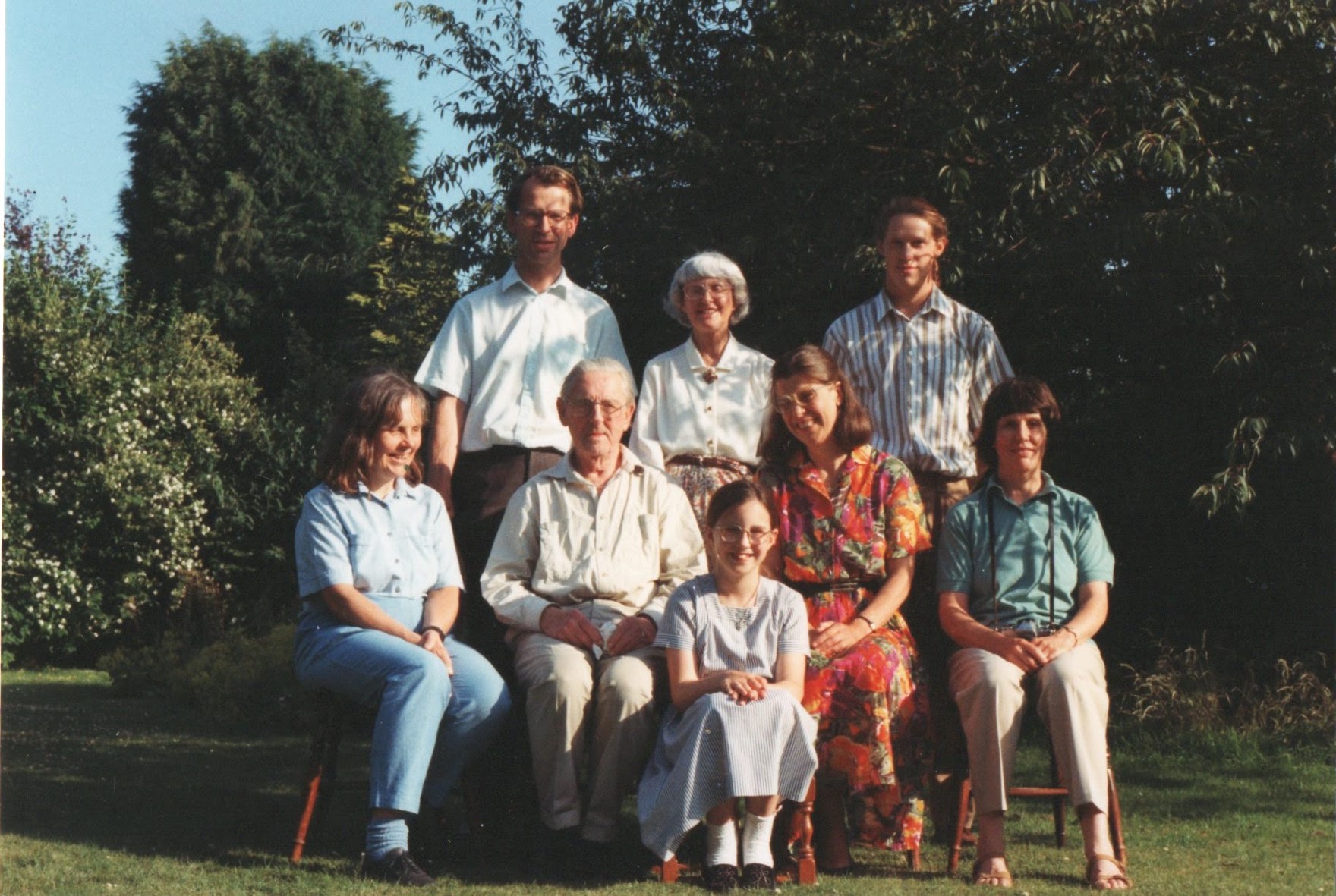
Doris died quite suddenly in December 1990, and John, now alone, held the fort, and dealt with everything, even baking bread and producing delicious sponge sandwiches and rock cakes. During his last years, John enjoyed visits from his children and seeing his neighbours, and going to their daughter’s wedding where he enjoyed meeting and talking to other guests.
He was still very fit on his 90th birthday in July 1993, but soon after that skin cancer took hold and he died in a hospice on 10th May 1995 having managed to stay at home until a few weeks before.
In his last year when the doctors could do no more for him, he told Peter that dying was a bit like leaving school, you didn’t know whether to be pleased or sad at the loss of contact.